
XGrammar 结构化解码缓存剖析:Unlimited 模式并发 Clear 字节记账竞态与代际修复(PR #1011)
在大语言模型服务(如 SGLang、vLLM)的结构化输出场景中,JSON Schema 或 EBNF 语法需要先编译为词表级掩码缓存(CompiledGrammar),才能在每个 Decode 步以微秒级开销生成合法 token 位图。XGrammar 通过 GrammarCompiler 维护编译产物的内存缓存,并提供 ClearCache() 与 GetCacheSizeBytes() 供上层推理引擎做显存/内存水位管理。
在阅读和审计 XGrammar(基线提交 614ab01d)的缓存实现时,我发现默认无容量上限(max_memory_bytes = -1,即 kUnlimitedSize)模式下存在两处紧密关联的缺陷:
- 静态记账残留:调用
ClearCache()会清空底层哈希表,但未重置grammar_level_cache_的原子字节计数器current_size_,导致清理后GetCacheSizeBytes()依然返回旧值,后续重编译同一 Schema 时字节数单调累加; - 并发在途记账竞态(Stale In-flight Charge):
ThreadSafeLRUCache为了避免耗时的语法编译阻塞并发读,将packaged_task放到锁外执行。如果在途编译尚未完成时另一线程调用了Clear(),旧编译任务结束时仍会无条件执行current_size_ += result.size,把已被清空驱逐的旧代际编译产物字节数错误计入新代际缓存。
本文沿着 GrammarCompiler 的源码路径,完整复盘双层缓存结构、锁分离并发模型、为什么 Unlimited 模式不能直接照搬 Finite 模式的阻塞清理逻辑,以及最终提交至上游的代际号(Generation Counter)+ 读写锁原子修复方案(mlc-ai/xgrammar PR #1011)。
一、GrammarCompiler 的双层缓存与自适应掩码开销
为什么结构化解码必须依赖编译器缓存?在 XGrammar 中,给定词表大小 (例如 32K 或 128K)和一条上下文无关文法 ,编译器需要对每个可扫描的有限状态机(FSM)节点预计算 AdaptiveTokenMask。对于状态 ,词表 被划分为三个互不相交的下标集合:
其中 是无论父规则上下文如何都必定合法的 token 集合, 是由首字节掩码(first_character_mask)或前缀树直接排除的非法集合, 则是推入字符后可能跨越当前规则末尾、需要在解码运行时结合父栈及 Lookahead 断言动态判定的不确定集合。
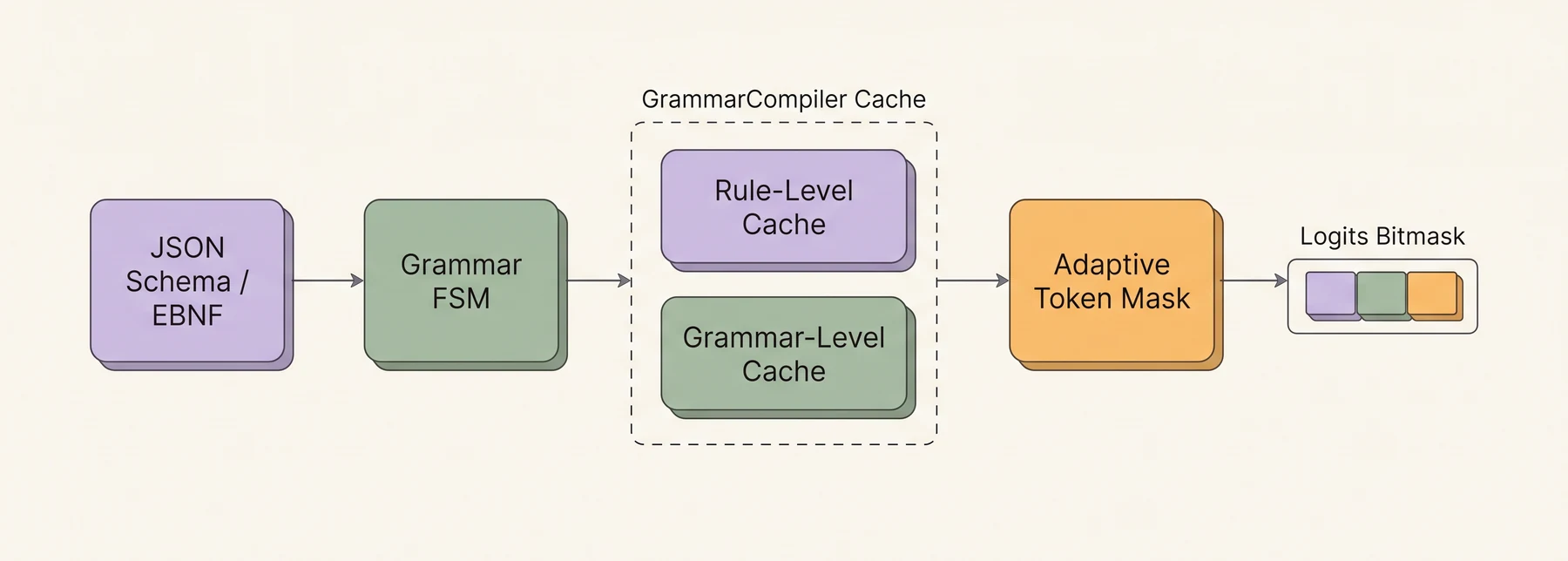
图 1:GrammarCompiler 的双层缓存架构。输入 Schema 或 EBNF 经 FSM 优化后,在规则级(Rule-Level)与语法级(Grammar-Level)两个粒度缓存 AdaptiveTokenMask。查看大图。
为了兼顾“完全相同的 Schema 复用”与“不同 Schema 之间共享常见子规则(如 JSON 字符串、数字、数组)”,GrammarCompiler::Impl 在构造时将总内存预算 max_memory_bytes 拆分为两层(见 cpp/grammar_compiler.cc):
- 规则级缓存(
rule_level_cache_):分配 内存预算(当max_memory_bytes == -1时为无上限(size_t)-1),以子规则 FSM 的结构哈希与 Lookahead 哈希为键,跨语法共享子规则状态的AdaptiveTokenMask; - 语法级缓存(
grammar_level_cache_):分配 内存预算(无上限时同样为kUnlimitedSize),底层是一个ThreadSafeLRUCache<UnionKey, CompiledGrammar, Computer, SizeEstimator>,直接缓存完整的CompiledGrammar实例。
上层查询缓存占用时,GetCacheSizeBytes() 会汇总两层缓存的字节数。一份中等复杂度的 JSON Schema 在 4096 词表下编译出的 CompiledGrammar 约占 1.83 MB(连同规则级缓存共约 2.11 MB),在 128K 词表下则会放大数十倍。因此,grammar_level_cache_.MemorySize() 的准确性直接关系到外部缓存管理器的水位判断。
二、问题复现与并发竞态根因分析
1. 静态清理残留:Clear 后不归零的计数器
我们先看修复前 cpp/support/thread_safe_cache.h 中 ThreadSafeLRUCache::Clear() 的原始实现:
void Clear() {
  // Remove all the ready entries.
  const auto lock_map = std::lock_guard{map_mutex_};
  if (this->max_size_ == kUnlimitedSize)
    cache_.GetMap().clear();
  else
    cache_.LRUEvict(
        [] { return true; },
        [&](const std::shared_future<SizedValue>& value) {
          // always evict and block until the value is ready
          try {
            current_size_ -= value.get().size;
          } catch (...) {
          }
          return true;
        }
    );
}
可以看到,当 max_size_ != kUnlimitedSize(有限容量模式)时,Clear() 通过 LRUEvict 逐个等待表项的 std::shared_future 就绪,并从 current_size_ 中减去 value.get().size。然而在默认开启的 kUnlimitedSize 分支下,代码为了跳过 LRU 双向链表维护,直接调用了 cache_.GetMap().clear(),却遗漏了对 current_size_ 的重置。
在单线程公开接口探针(词表大小 4096,编译含 16 个字段约束的 JSON Schema)中,这一遗漏表现为:
| 阶段 | Unlimited 基线(修复前) | Finite 对照(16 MiB) |
Unlimited 修复后 |
|---|---|---|---|
初始状态 cache_before_bytes |
0 B |
0 B |
0 B |
首次 CompileJSONSchema 后 |
2,109,420 B |
2,109,420 B |
2,109,420 B |
调用 ClearCache() 后 |
1,829,544 B(异常残留) |
0 B |
0 B |
| 再次编译同一 Schema 后 | 3,938,964 B(翻倍累加) |
2,109,420 B |
2,109,420 B |
表中的 1,829,544 B 正好是该 CompiledGrammar 在 grammar_level_cache_ 中的大小(其余 279,876 B 位于 rule_level_cache_,后者在 ClearCache() 中被正常清零)。每次清理后重编译,语法级缓存的记账都会凭空多出一份幽灵体积。
2. 为什么只加一行 current_size_ = 0 不够?
如果只在 cache_.GetMap().clear() 后面加上 current_size_ = 0;,单线程用例确实能通过,但在多线程并发编译场景下依然存在竞态。原因在于 GetFutureUnlimited 的锁分离(Lock-split)执行模型:
// 修复前的 GetFutureUnlimited 核心逻辑
auto task = std::packaged_task<SizedValue()>{[this, &key] {
  auto value = computer_(key);
  auto result = SizedValue{value, size_estimator_(value)};
  current_size_ += result.size; // <--- 锁外无条件累加!
  return result;
}};

auto lock_map = std::unique_lock{map_mutex_};
auto [it, success] = map.try_emplace(key);
if (!success) return it->second.value;

auto future = task.get_future().share();
it->second.value = future;

// perform the costly computation outside all locks
lock_map.unlock();
task();
return future;
为了不让长达数十毫秒的 computer_(key) 阻塞其他线程查询缓存,线程 A 在哈希表中插入未就绪的 std::shared_future 后立即调用 lock_map.unlock(),在锁外执行 task()。考虑如下并发交错时序:
- 时刻 :线程 A 请求编译
key = K,持独占锁插入future_0,随后释放锁,开始在锁外执行耗时的computer_(K); - 时刻 :线程 B 调用
Clear(),获取map_mutex_独占锁,清空哈希表并将current_size_置为0后返回; - 时刻 :线程 C 再次请求编译同一个
key = K,由于哈希表已空,线程 C 插入新的future_1并完成编译,此时缓存真实占用为 ; - 时刻 :线程 A 的旧计算终于完成,在闭包末尾执行
current_size_ += S_0。此时哈希表里根本没有线程 A 的条目,但current_size_被污染成了 。
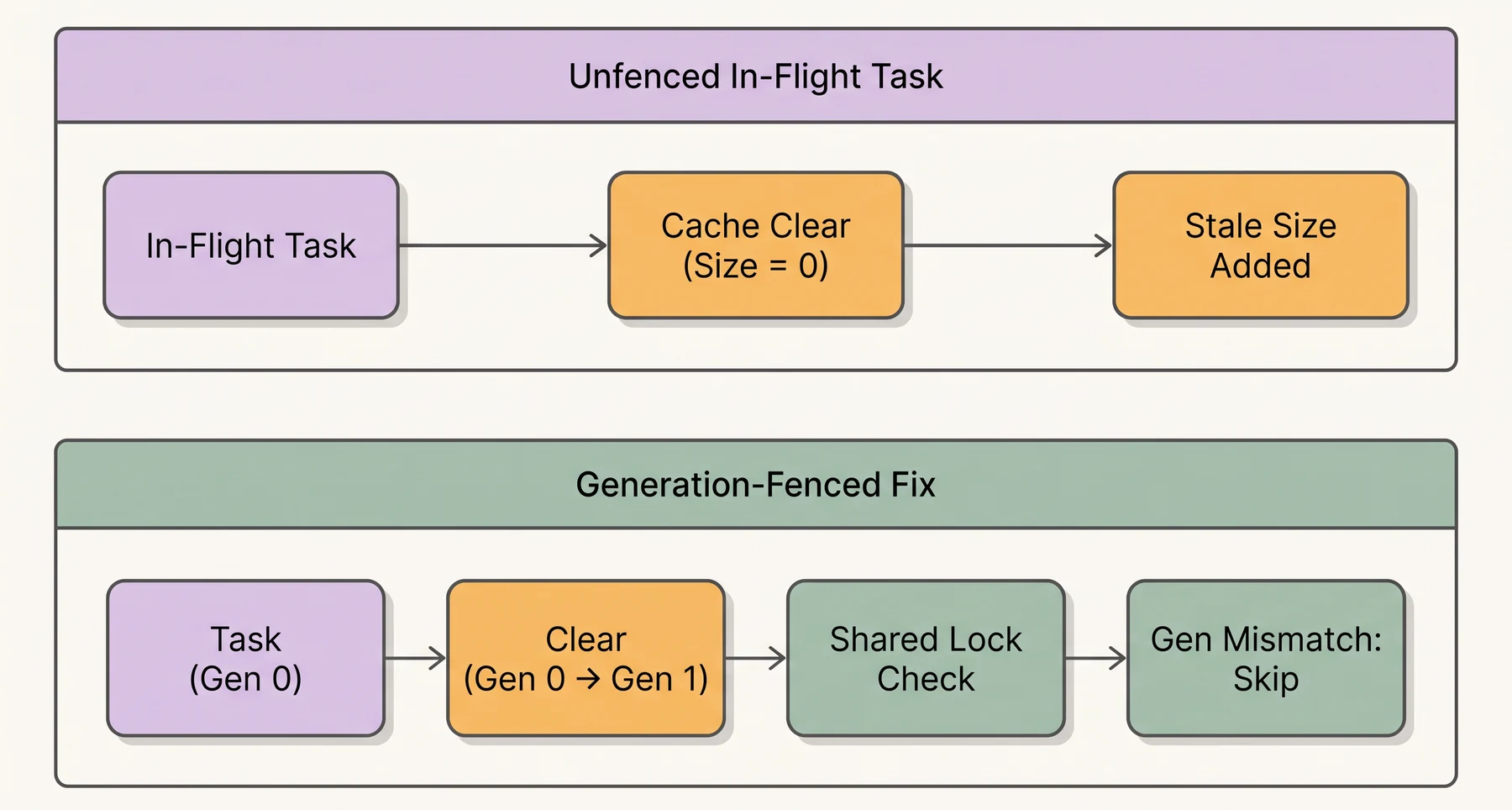
图 2:并发交错下的记账竞态(上)与代际围栏修复(下)。旧代际的在途任务在 Clear() 之后完成时,通过共享锁校验代际号即可避免向新代际累加幽灵字节。查看大图。
3. 为什么 Unlimited 模式不能照搬 Finite 模式阻塞等待?
一个自然的追问是:既然 Finite 模式的 Clear() 会通过 value.get() 阻塞等待所有在途 shared_future 算完再扣减尺寸,为什么 Unlimited 模式不这样做?
答案有两个层面的考量:
- 非阻塞清理契约与尾延迟:Unlimited 模式不维护 LRU 链表,调用方在触发
Clear()时预期的是 释放字典引用的快速操作,而不希望被后台正在编译的超长 Schema 阻塞数十乃至数百毫秒;已在等待old_future的旧调用方通过shared_future依然能正常拿到自己的返回值或异常,无需Clear()替它们同步等待。 - 持锁等待的死锁风险:Finite 模式的
Clear()是在持有map_mutex_独占锁期间调用value.get()的。如果某个在途编译任务内部(或自定义computer_回调中)间接触发了对同一个缓存的读取或清理,持锁等待future会立刻造成死锁。因此,保持 Unlimited 模式Clear()的非阻塞特性是更安全的系统设计。
三、代际号(Generation Counter)+ 读写锁原子修复
既然允许旧代际的在途编译在 Clear() 返回后继续跑完,那么核心不变量就应当定义为:每一次 Clear() 都会开启一个新的缓存代际(Generation);只有当编译任务所属的代际与当前缓存代际相同时,其产物的字节数才允许计入 current_size_。
要让这条不变量在并发环境下严格成立,必须注意一个极易踩坑的细节:不能只用原子变量比较 generation == generation_,然后再执行 current_size_ += result.size。如果比较与累加不是相对 Clear() 原子的,线程 A 刚刚判断完 generation == generation_ 为真,线程 B 就切进来执行完整个 Clear()(将 generation_ 加一并将 current_size_ 清零),随后线程 A 继续执行下一行 current_size_ += result.size,竞态依然会发生!
正确的做法是利用现有的 std::shared_mutex map_mutex_:
Clear()原本就持有独占锁std::lock_guard{map_mutex_},在独占锁内同时完成++generation_、cache_.GetMap().clear()和current_size_ = 0;- 编译任务在锁外完成耗时的
computer_(key)与size_estimator_(value)后,获取轻量级的读共享锁std::shared_lock{map_mutex_},在共享锁保护下检查if (generation == generation_) current_size_ += result.size;。
这样一来,多个并发编译任务完成时的记账可以彼此并行(共享锁互不阻塞),但任何任务做代际校验与字节累加的瞬间,都与 Clear() 的独占锁严格互斥,彻底消除了 TOCTOU(Time-of-Check to Time-of-Use)窗口。同时,我还顺手修复了原代码在 unique_lock 之前就构造 packaged_task 的小瑕疵——改为在持有 unique_lock 确认第二次查找仍未命中后,才捕获当前 generation_ 并构造 task。
核心补丁(cpp/support/thread_safe_cache.h)如下:
  void Clear() {
    // Remove cached entries.
    const auto lock_map = std::lock_guard{map_mutex_};
    if (this->max_size_ == kUnlimitedSize) {
      // In-flight computations still return their values, but no longer belong to this cache.
      ++generation_;
      cache_.GetMap().clear();
      current_size_ = 0;
    } else
      cache_.LRUEvict(
          [] { return true; },
          [&](const std::shared_future<SizedValue>& value) {
            // always evict and block until the value is ready
            try {
              current_size_ -= value.get().size;
            } catch (...) {
              // fine, just ignore the exception, size is not updated
            }
            return true;
          }
      );
  }
以及 GetFutureUnlimited 的代际捕获与共享锁记账实现:
  std::shared_future<SizedValue> GetFutureUnlimited(const Key& key) {
    auto& map = cache_.GetMap();

    {
      auto lock_map = std::shared_lock{map_mutex_};
      auto it = map.find(key);
      if (it != map.end()) return it->second.value;
    }

    auto lock_map = std::unique_lock{map_mutex_};
    auto it = map.find(key);
    if (it != map.end()) return it->second.value;

    const auto generation = generation_;
    auto task = std::packaged_task<SizedValue()>{[this, &key, generation] {
      auto value = computer_(key);
      auto result = SizedValue{value, size_estimator_(value)};
      // Serialize the generation check and accounting with Clear().
      auto lock_map = std::shared_lock{map_mutex_};
      if (generation == generation_) current_size_ += result.size;
      return result;
    }};

    auto future = task.get_future().share();
    map.try_emplace(key).first->second.value = future;

    // perform the costly computation outside all locks
    lock_map.unlock();
    task();
    return future;
  }
四、零 Sleep 的确定性并发单测与死锁门卫设计
并发 Bug 的回归测试最忌讳依赖 std::this_thread::sleep_for 碰运气。为了在 GoogleTest 中 100% 确定性地复现并验证上述跨代交错时序,我在 tests/cpp/test_thread_safe_cache.cc 中使用两对 std::promise<void>(entered 与 release)构造了精确的同步屏障,并用参数化测试 TEST_P(UnlimitedCacheClearTest, ...) 同时覆盖旧任务正常返回与抛出异常两条路径:
class UnlimitedCacheClearTest : public ::testing::TestWithParam<bool> {};

TEST_P(UnlimitedCacheClearTest, InFlightCompletionDoesNotChargeANewerGeneration) {
  using namespace std::chrono_literals;
  std::promise<void> entered;
  auto entered_future = entered.get_future();
  std::promise<void> release;
  auto release_future = release.get_future().share();
  std::atomic<int> calls{0};
  const bool fail_first = GetParam();
  auto compute = [&](const int& key) {
    EXPECT_EQ(key, 7);
    const int call = ++calls;
    if (call == 1) {
      entered.set_value();
      release_future.wait();
      if (fail_first) throw std::runtime_error("first computation failed");
    }
    return call * 17;
  };
  auto estimate = [](int value) { return static_cast<std::size_t>(value); };
  using Cache = ThreadSafeLRUCache<int, int, decltype(compute), decltype(estimate)>;
  Cache cache(Cache::kUnlimitedSize, compute, estimate);
  std::future<int> old_get, new_get;
  std::future<void> clear;
  struct ReleaseGuard {
    std::promise<void>& promise;
    bool released{false};
    void Release() {
      if (!released) {
        promise.set_value();
        released = true;
      }
    }
    ~ReleaseGuard() { Release(); }
  } release_guard{release};
  // Destroy the guard before the futures, so any early exit unblocks their computations.
  old_get = std::async(std::launch::async, [&] { return cache.Get(7); });

  if (entered_future.wait_for(5s) != std::future_status::ready) {
    release_guard.Release();
    old_get.wait();
    FAIL() << "The old computation did not start";
  }
  clear = std::async(std::launch::async, [&] {
    cache.Clear();
    cache.Clear();
  });
  if (clear.wait_for(5s) != std::future_status::ready) {
    release_guard.Release();
    old_get.wait();
    clear.wait();
    FAIL() << "Unlimited Clear blocked on an in-flight computation";
  }
  clear.get();
  EXPECT_EQ(cache.MemorySize(), 0);

  // Reuse the same key before the old computation finishes.
  new_get = std::async(std::launch::async, [&] { return cache.Get(7); });
  if (new_get.wait_for(5s) != std::future_status::ready) {
    release_guard.Release();
    old_get.wait();
    new_get.wait();
    FAIL() << "Clear did not remove the old in-flight entry";
  }
  EXPECT_EQ(new_get.get(), 34);
  EXPECT_EQ(cache.MemorySize(), 34);
  EXPECT_EQ(cache.Get(7), 34);
  EXPECT_EQ(calls, 2);
  cache.Clear();
  EXPECT_EQ(cache.MemorySize(), 0);
  EXPECT_EQ(cache.Get(7), 51);
  EXPECT_EQ(cache.MemorySize(), 51);

  release_guard.Release();
  if (fail_first) {
    EXPECT_THROW(old_get.get(), std::runtime_error);
  } else {
    EXPECT_EQ(old_get.get(), 17);
  }
  EXPECT_EQ(cache.MemorySize(), 51);
  EXPECT_EQ(cache.Get(7), 51);
  EXPECT_EQ(calls, 3);
}
这段测试代码中有两个非常关键的工程防卫设计:
- C++ 栈对象逆序析构与
ReleaseGuard声明位置:std::async返回的std::future在析构时会隐式阻塞等待异步线程结束。如果release_guard声明在old_get之前,一旦测试中途因某条断言失败或异常提前退栈,old_get会先于release_guard析构,而此时old_get还在等待release_future,从而造成测试进程永久死锁。将release_guard声明在old_get, new_get, clear之后,保证栈展开时~ReleaseGuard()第一个执行,自动解开release屏障。 - 异步重查与 5 秒死锁超时门卫:在
Clear()之后,第 2 代首次查询同一个key = 7(new_get)同样放在std::async中并用wait_for(5s)保护。这样即便未来有人误删了cache_.GetMap().clear()导致new_get拿到旧的未就绪shared_future,测试也会在 5 秒后干净报错退出,而不会挂死整个 CI。
五、全量编译审计、回归验证与实现边界
在修改头文件 cpp/support/thread_safe_cache.h 后,我首先使用 clang++ -MM 对仓库全部 43 个编译单元(Translation Units)做了传递头文件依赖扫描(保存于 dependency-audit.json),确认仅有编号 15(cpp/grammar_compiler.cc)与编号 39(tests/cpp/test_thread_safe_cache.cc)依赖该头文件。
在相同编译参数(macOS arm64,clang++ -std=c++17 -O1 -pthread)下,将新增的 4 项参数化回归测试分别链接到未修改基线与修复后的目标文件:
| 测试用例 | 测试目标 | 未修改基线(Baseline) | 修复后(Fixed) |
|---|---|---|---|
CompilerCacheClearTest/0 (max_bytes = -1) |
Unlimited 公开编译器 ClearCache 与重编译记账 |
FAILED(Clear 后残留 504 B,重编后涨至 1012 B vs 预期 508 B) |
PASSED(0 -> 508 -> 0 -> 508 -> 0) |
CompilerCacheClearTest/1 (max_bytes = 1 MiB) |
Finite 公开编译器 ClearCache 与重编译记账 |
PASSED(0 -> 508 -> 0 -> 508 -> 0) |
PASSED(0 -> 508 -> 0 -> 508 -> 0) |
UnlimitedCacheClearTest/0 (fail_first = false) |
并发在途编译成功完成时不污染新代际缓存值与字节数 | FAILED(Clear 后未清零,且旧任务完成后多加 17 B) |
PASSED(保持第 3 代 51 B 不变,旧调用方仍拿到 17) |
UnlimitedCacheClearTest/1 (fail_first = true) |
并发在途编译抛异常时不污染新代际状态 | FAILED(跨代清理期间 MemorySize() 未清零) |
PASSED(旧调用方正常捕获 runtime_error,新代际保持 51 B) |
| 全量原生 C++ 测试集(87 项) | 覆盖 EBNF、JSON Schema、Regex、Structural Tag 等全部单测 | 83 passed(不含新增 4 项) | 87 passed, 0 failed(总耗时 1.02 s) |
适用范围与工程边界说明
- 修复的是容量记账缺陷(Accounting Defect),而非物理内存泄漏:在修复前,
cache_.GetMap().clear()已经正确析构了哈希表中的std::shared_future节点,底层CompiledGrammar的引用计数在无人持有时已正常释放;缺陷在于原子计数器current_size_未归零且未对跨代在途任务加围栏,导致对外报告的缓存水位失真。 - 语法级缓存与规则级缓存的边界:本次修复针对的是
ThreadSafeLRUCache(即grammar_level_cache_)。如果在调用GrammarCompiler::ClearCache()时恰好有在途的多线程语法编译正在运行,该在途编译内部的GrammarMatcherForTokenMaskCache仍可能继续向独立的rule_level_cache_写入子规则掩码。要将rule_level_cache_也纳入同一代际围栏,需要跨组件传递编译代际上下文,不在本次最小正交补丁的修改范围内。 - 验证环境边界:本地回归验证基于 C++17 原生构建与公开 C++ API 探针(并已通过仓库全量
pre-commit、clang-format 19.1.7与ruff check),不包含 Python 绑定层或 GPU 端到端推理吞吐测试。补丁已提交为上游 PR #1011。
本文封面与两张架构示意图使用 aigc-image-generator 辅助生成并经人工核对,用于展示缓存层级与代际并发时序;精确锁粒度与状态转移以文中 C++ 源码为准。